Your Freight Shares Our Trucks. Here’s How We Calculate Your LTL Emissions.
More customers are asking us for one number: How much did my freight actually emit?
You need that figure for your own environmental reporting, and you need to trust it.
That’s a straightforward question for a full truckload, where one shipment fills the whole trailer. It’s a different question for less-than-truckload (LTL) freight, where your shipment is riding alongside everyone else’s.
Why LTL Shipment Emissions Aren’t Split Evenly
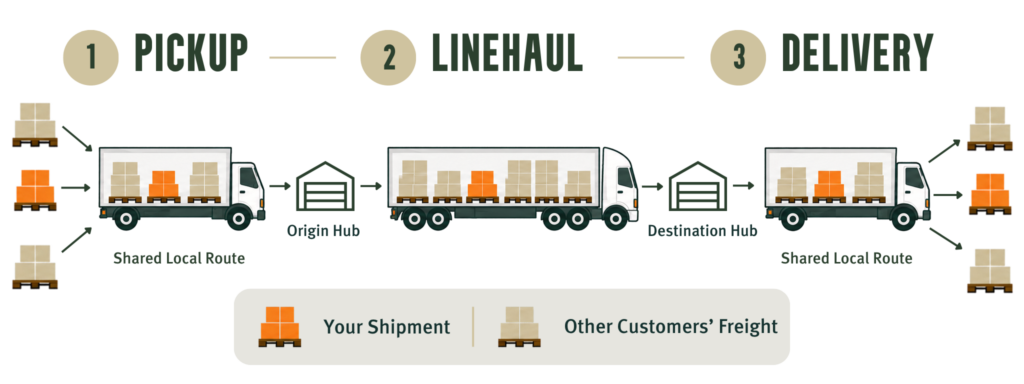
The orange pallet in the illustration is one customer’s shipment, sharing truck space with other customers’ freight. Every shipment on that truck takes its share of the fuel it burns and the miles it travels, but not an equal share.
Two shipments can sit side by side and still be very different: one might weigh twice as much, take up half the space, or travel only a fraction of the distance once the truck starts making stops. Split the truck’s emissions evenly across every shipment, and every customer gets the same number, whether their freight rode the whole route or came off at the first stop.
How Pyle Calculates Your Shipment’s Emissions
So we don’t split it evenly. We built a system that pulls Pyle’s actual fuel, mileage, and shipment data and works out each shipment’s share based on its weight, the space it took up and the distance it traveled.
That same weight-space-distance math also has to run separately for each vehicle your freight rides in. The orange shipment in the illustration starts and ends on a local pickup-and-delivery truck and travels between hubs on a linehaul tractor-trailer.
Those two vehicles run very differently, so we work out the emissions for each leg on its own, using the fuel and mileage specific to that vehicle, then add the legs together for one number covering the whole shipment.
The result reflects what actually happened on the road for that shipment. When you ask us for your shipment’s emissions, that’s the number you get, one specific to your freight that you can use in your own reporting.
Looking for More Insight Into Your Freight Emissions?
Learn more about Pyle’s approach to environmental sustainability and how we’re helping customers better understand their transportation footprint through our CleanJourney program.
You May Like

A. Duie Pyle’s Commitment to Sustainability: Meet Laurie Mack
A. Duie Pyle has long invested in sustainability, but with growing customer interest in reducing emissions and environmental impact, the company created a new role to bring these efforts together into a unified program. Laurie

Driving a Sustainable Future with Renewable Diesel
The transportation industry is essential to the global economy, but it also produces almost 30% of U.S. greenhouse gas emissions. Many businesses are looking for ways to become more sustainable, but how can they do